
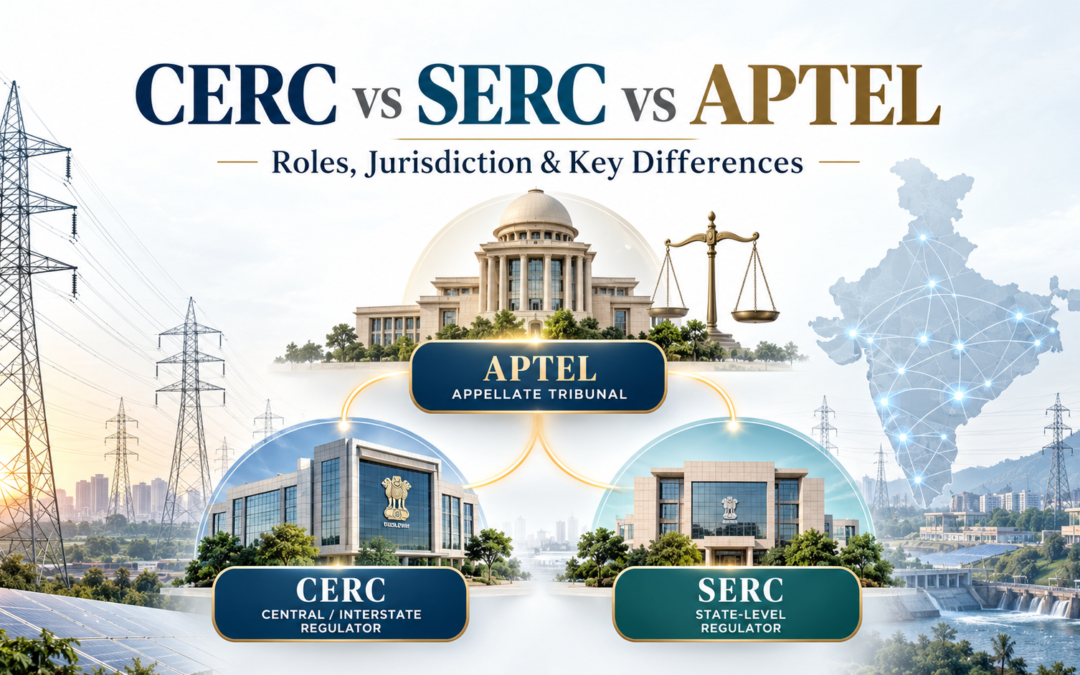
Ask a young lawyer where to file an electricity case, and there’s usually a pause before the answer. That’s not because they slept through law school. It’s because the power sector doesn’t have one judge it has three, and each one hears only certain kinds of disputes.
The Electricity Act, 2003 set up this structure on purpose: two regulators, and one appeals court above them. File in the wrong place, and the case can get thrown out before anyone even looks at what actually happened.
CERC: the traffic cop for electricity that crosses state lines
The Central Electricity Regulatory Commission looks after power that moves between states. That includes tariffs for big central power plants like NTPC’s, interstate transmission lines, power exchanges such as IEX, and fights between generators and licensees who operate in more than one state.
A good example came up in February 2026. India Energy Exchange challenged a CERC order on “market coupling” a system that matches bids from different power exchanges into one common price. APTEL let the order stand, even though detailed rules hadn’t been finalised yet. Around the same time, CERC’s power to send disputes to arbitration instead of deciding them itself was questioned in a case involving Damodar Valley Corporation. Everyone agreed CERC has that power. What they argued about was how much freedom the word “refer” actually gives it.
SERC: the one that actually decides your electricity bill
Every state has its own regulator in Rajasthan, the RERC. It looks after retail tariffs, distribution licences, and increasingly, the state’s push toward solar and wind power.
These orders involve real money. In 2026, RERC approved ₹3,779.89 crore in transmission charges for Rajasthan’s transmission company, well below its ₹4,605.71 crore claim. It also found that Jodhpur’s DISCOM had actually made a profit of ₹413.92 crore in FY 2024-25, though the company itself had claimed a loss of ₹188.46 crore.
And RERC’s decisions go beyond just fixing prices:
- It turned down a plan to buy 3.2 GW of power from coal-based plants, choosing cleaner sources instead
- It extended the rules for renewable energy tariffs up to 2028, so solar and wind companies know what to expect
- It brought in new rules to make sure Rajasthan has enough power capacity planned in advance
- It allowed a wind power company to recover the cost of installing devices that stop birds from flying into turbine blades, to protect the Great Indian Bustard.
Each of these looks like a routine regulatory order. But together, they quietly decide what Rajasthan’s power sector will look like ten years from now.
When CERC and SERC won’t share the sandbox
On paper, the split is simple: CERC for interstate matters, SERC for everything within a state. In practice, the line gets tested often. In one case, a state regulator rewrote a power sale agreement to grab a dispute that actually belonged to CERC, since the deal involved the Solar Energy Corporation of India selling power across state lines. APTEL struck it down. Its message was clear: a state commission cannot give itself jurisdiction just by changing a contract’s wording.
APTEL is the court that gets the final word
Above both commissions sits the Appellate Tribunal for Electricity. It exists because the Supreme Court said, back in 2002, that the power sector needed an appeals body with legal and technical experts on the bench, not just judges. Anyone unhappy with a CERC or SERC order can appeal within forty-five days. APTEL can even direct a commission to do its job properly a power most tribunals don’t have.
The law expects appeals to be decided within 180 days. In reality, that rarely happens. A 2025 report, based on Right to Information data, found 2,662 cases still pending before APTEL, with 1,697 of those waiting more than three years. Some go back to 2013. Long vacancies in the Chairperson’s and technical member posts haven’t helped.
One law, three forums, and no easy shortcuts
What makes this structure interesting is that no single body has the final say on everything. A power company negotiating one contract might need CERC for the tariff, the state SERC for a connected distribution issue, and APTEL for the appeal all within the same dispute. Choosing the wrong forum doesn’t just cause delay. APTEL can send a case back, but it cannot create jurisdiction for a commission that never had it to begin with
More than two decades after the Act was passed, lawyers, regulators and companies are still working out exactly where one authority ends and the next one begins.
“Three forums, one law and every electricity dispute in India still begins with the same question: whose desk does this actually belong on?”
FREQUENTLY ASKED QUESTIONS
Q1. What are CERC, SERC and APTEL, in simple terms?
CERC is the central electricity regulator, for power that crosses state lines. SERC is the regulator in each state, and in Rajasthan it is RERC. APTEL is the appeals tribunal above both of them. The two regulators make decisions, and APTEL is where you go if you think a decision was wrong.
Q2. I have a problem with my electricity bill. Which one do I go to?
None of the three first. Start with your power company’s complaint channel, then your state’s consumer grievance forum, and then the Electricity Ombudsman if the forum doesn’t help.
Q3. What happens if I file in the wrong place?
Your case can be sent back or rejected without anyone looking at the dispute itself. APTEL has set aside orders where a state commission took on a dispute that belonged to CERC.
Q4. If I lose before CERC or the state commission, what can I do?
You can appeal to APTEL within 45 days of the order. Missing that deadline is a serious problem, so keep track of the date from the day you receive the order.
Q5. Is APTEL the final word? Can I go further?
APTEL is the last stop within the electricity system, but it is not the end of the road. A further appeal can go to the Supreme Court.
Q6. Do I need a lawyer to approach these bodies?
For small consumer complaints, usually not. For tariff petitions, contract disputes and appeals, most companies hire lawyers, because the procedure and deadlines are strict.