
Amicus Publico LLP

Top Electricity Law Dispute Firm in India — Powering Your Legal Position in a High-Stakes Sector
India’s electricity sector is highly regulated, making electricity law disputes complex and high-value. Issues involving Power Purchase Agreements (PPAs), tariff disputes, Change in Law claims, and regulatory compliance require experienced legal representation.
Amicus Publico LLP is a Top Electricity Law Dispute Firm in India, representing generators, DISCOMs, and consumers before CERC, SERCs, APTEL, and the Supreme Court of India. Our team delivers strategic solutions for complex electricity litigation, regulatory proceedings, and commercial power sector disputes.
25+
YEARS OF COMBINED PRACTICE
1200+
MATTERS HANDLED
40+
REPORTED JUDGMENTS
15+
INDUSTRY SECTORS
Our Electricity Law Dispute Services in India
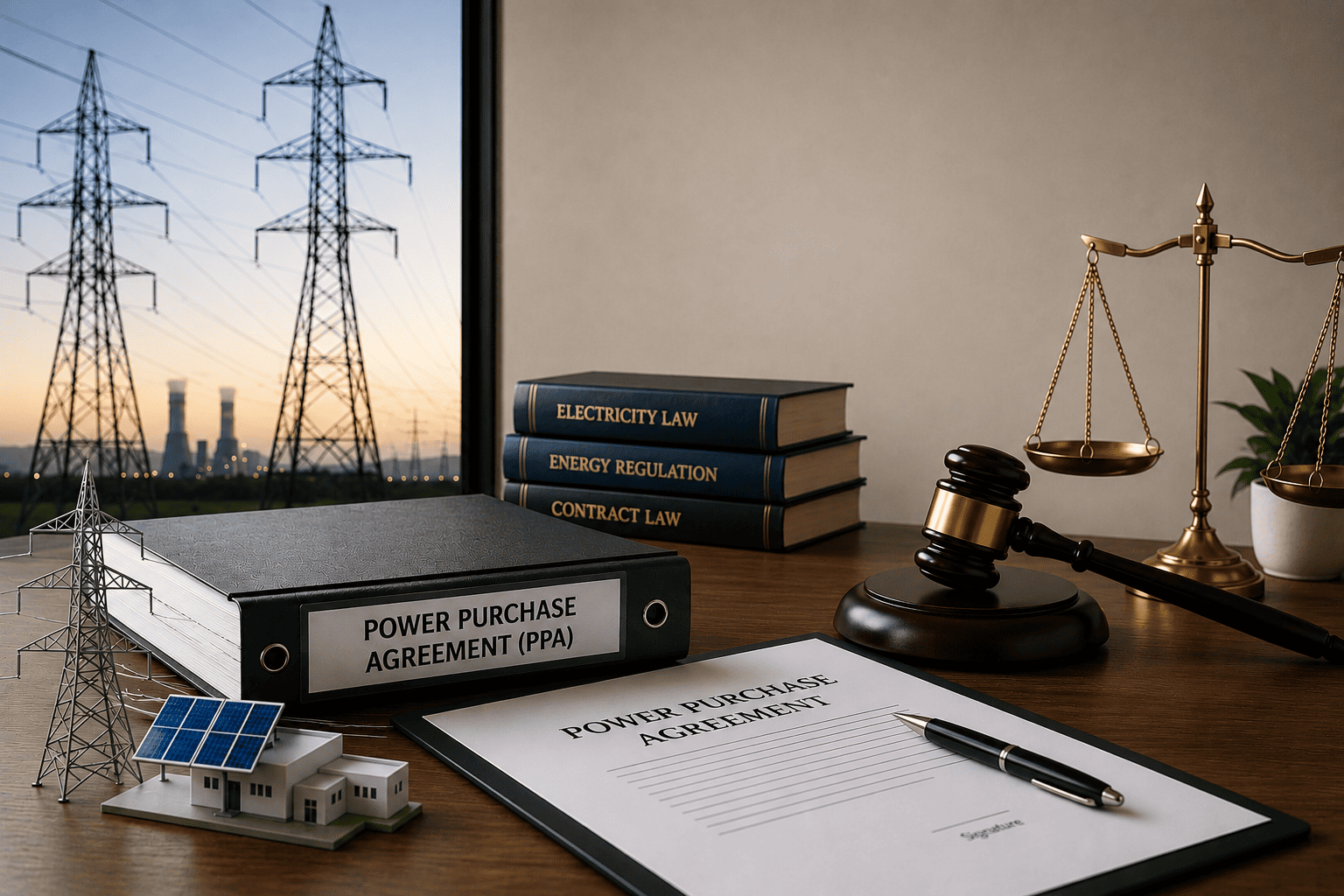
Power Purchase Agreements (PPAs) are the foundation of India's electricity sector, governing long-term relationships between power generators and DISCOMs. When disputes arise, they can have significant financial and regulatory consequences.
As a Top Electricity Law Dispute Firm in India, we represent clients in PPA disputes, including:
- Tariff Disputes – Challenging unlawful tariff revisions, payment defaults, and disputes over tariff determination.
- Change in Law Claims – Securing tariff compensation for taxes, policy changes, and regulatory developments affecting project viability.
- Curtailment & Scheduling Disputes – Protecting generators against unlawful power curtailment, backing-down instructions, and scheduling violations under PPAs and Grid Code regulations.
Our team represents clients before CERC, SERCs, APTEL, and the Supreme Court of India, delivering strategic solutions for complex electricity law disputes.
Proceedings Before CERC and SERCs
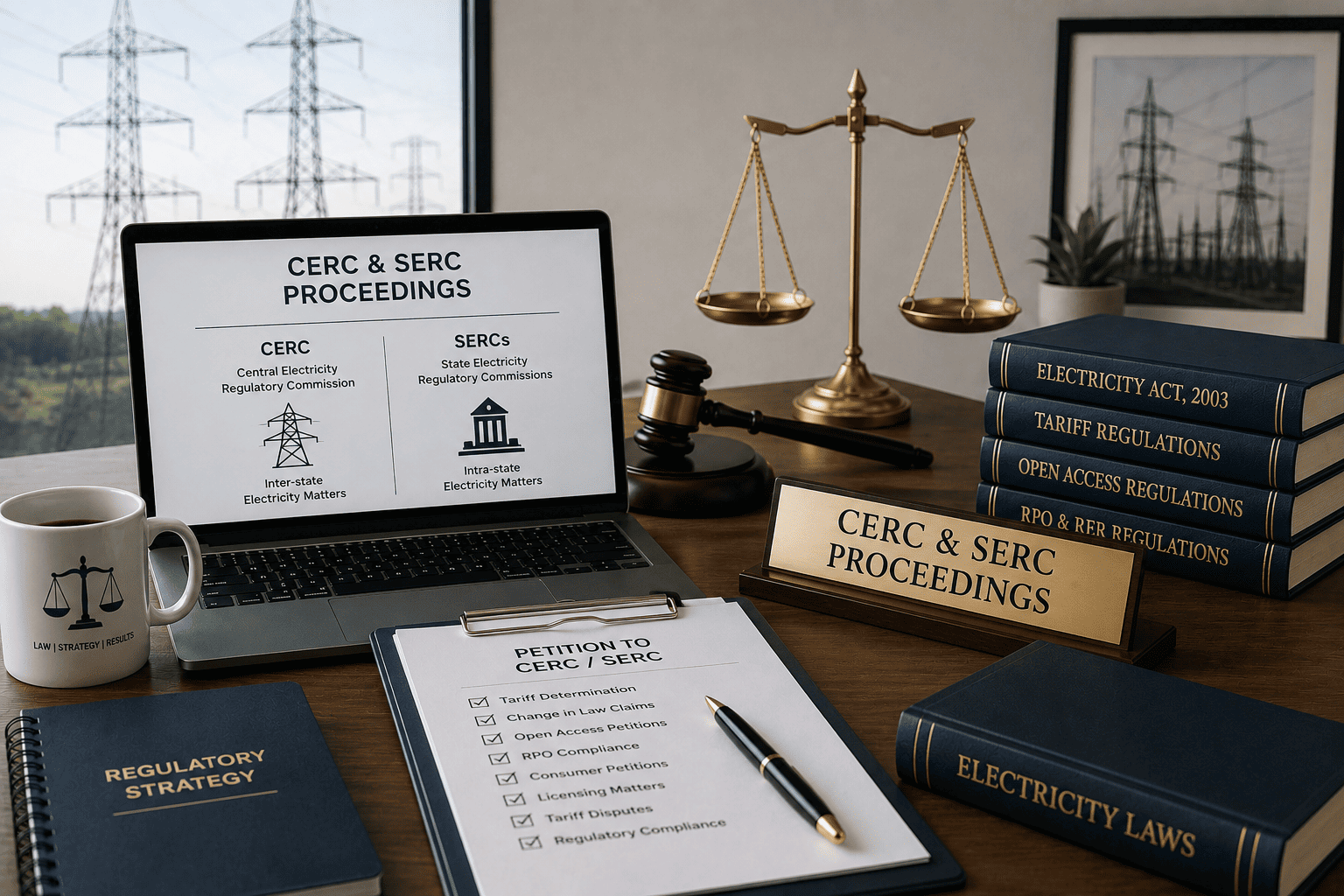
CERC and State Electricity Regulatory Commissions (SERCs) are the primary forums for resolving electricity law disputes in India. CERC deals with inter-state electricity matters, while SERCs handle intra-state tariff, open access, generation, distribution, and consumer disputes.
Our team prepares and represents clients in CERC and SERC proceedings, ensuring well-drafted petitions, strong evidence, and effective advocacy to secure favourable regulatory outcomes.
We represent clients before CERC and all major SERCs on:
- Petition filings for tariff determination, tariff revision, and true-up claims
- Change in Law petitions — framing, evidence, and quantification
- Open access petitions — including cross-subsidy surcharge and wheeling charge disputes
- Renewable Purchase Obligation (RPO) compliance and enforcement
- Consumer petitions before SERCs for large industrial and commercial consumers
- Licence applications, amendments, and revocations
- challenging tariff categorisation, demand charges, or arbitrary disconnection
Regulatory compliance defence, including responses to show cause notices and enforcement proceedings
Proceedings Before CERC and SERCs
CERC and State Electricity Regulatory Commissions (SERCs) are the key authorities for resolving electricity law disputes in India. CERC oversees inter-state transmission, tariffs, and power trading, while SERCs regulate intra-state tariffs, open access, generation, distribution, and consumer matters.
Our electricity law experts represent clients before CERC and SERCs, preparing strong petitions, presenting compelling evidence, and securing effective regulatory remedies.
We represent clients before CERC and all major SERCs on:
- Petition filings for tariff determination, tariff revision, and true-up claims
- Change in Law petitions — framing, evidence, and quantification
- Open access petitions — including cross-subsidy surcharge and wheeling charge disputes
- Renewable Purchase Obligation (RPO) compliance and enforcement
- Licence applications, amendments, and revocations
- Consumer petitions before SERCs for large industrial and commercial consumers
- challenging tariff categorisation, demand charges, or arbitrary disconnection
Regulatory compliance defence, including responses to show cause notices and enforcement proceedings
APTEL Appeals — Appellate Tribunal for Electricity
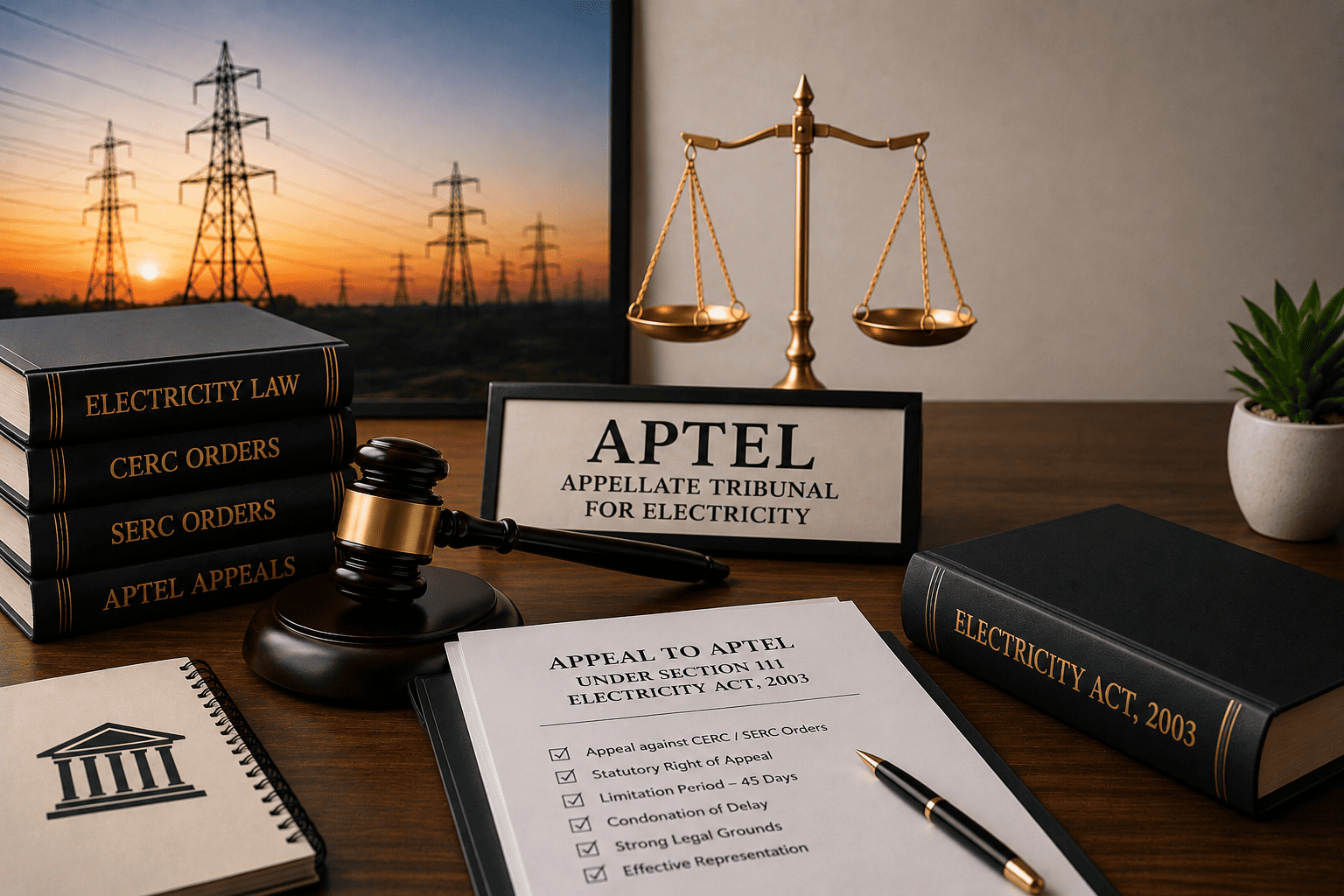
The Appellate Tribunal for Electricity, constituted under Section 111 of the Electricity Act, 2003, is India's national appellate body for orders of CERC, all SERCs, and Joint Electricity Regulatory Commissions. Anyone aggrieved by such an order has a statutory right of appeal to APTEL, to be filed within forty-five days — though APTEL may condone delay where sufficient cause is shown.
Renewable Energy Disputes
India has committed to 500 GW of non-fossil fuel capacity by 2030, with solar and wind at the core. Disputes in this space are both familiar and genuinely new: traditional PPA disputes over tariff, curtailment, and force majeure sit alongside novel questions around storage-backed renewable contracts, virtual PPAs, hybrid project configurations, green hydrogen offtake agreements, and the evolving framework for firm, dispatchable renewable power.
As the Draft NEP 2026 accelerates India's shift to a renewables-heavy grid, disputes in this space are only going to get more complex.
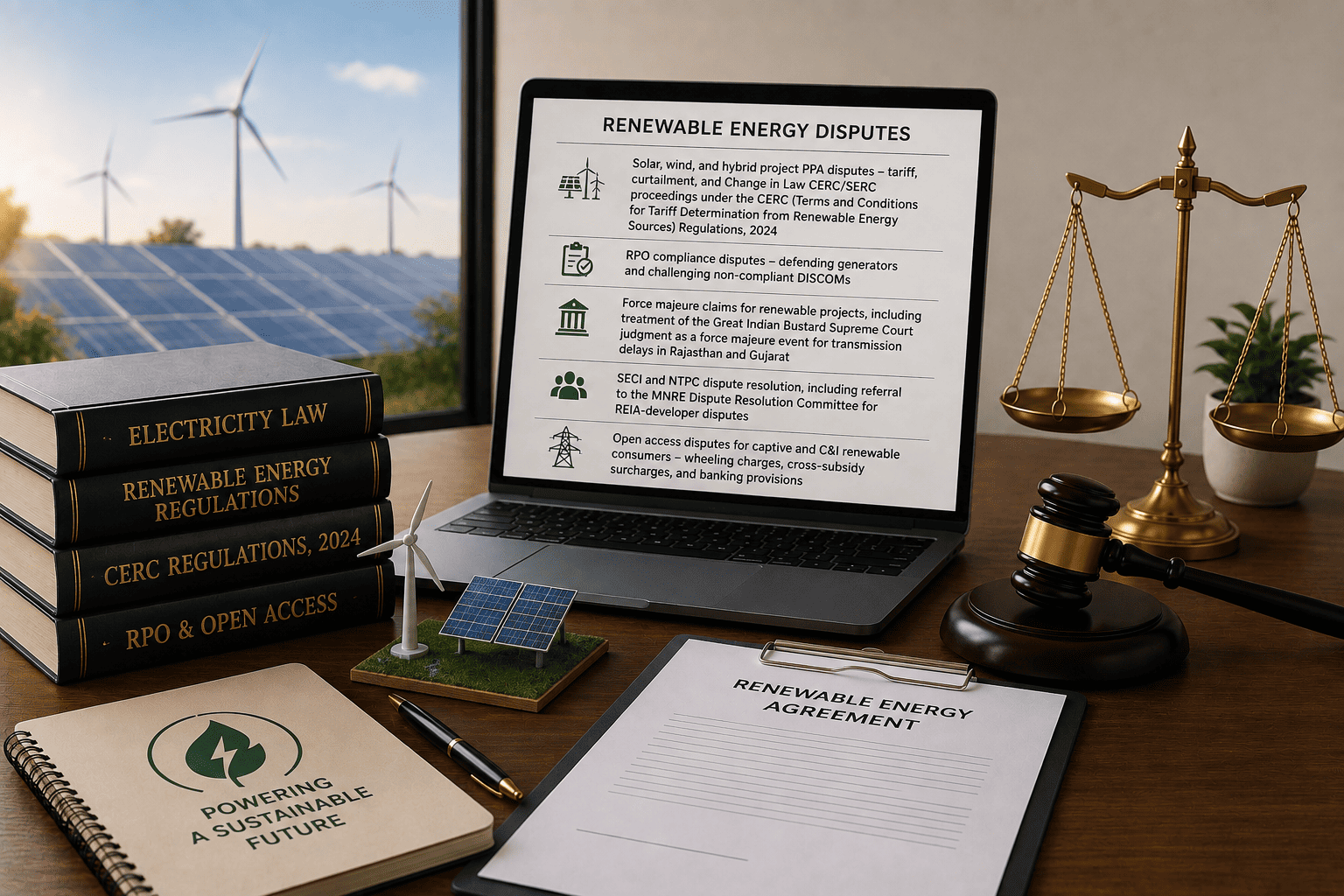

We advise renewable energy developers, investors, and offtakers on:
Solar, wind, and hybrid project PPA disputes — tariff, curtailment, and Change in Law CERC/SERC proceedings under the CERC (Terms and Conditions for Tariff Determination from Renewable Energy Sources) Regulations, 2024
- RPO compliance disputes — defending generators and challenging non-compliant DISCOMs
- Force majeure claims for renewable projects, including treatment of the Great Indian Bustard Supreme Court judgment as a force majeure event for transmission delays in Rajasthan and Gujarat
- SECI and NTPC dispute resolution, including referral to the MNRE Dispute Resolution Committee for REIA-developer disputes
- Open access disputes for captive and C&I renewable consumers — wheeling charges, cross-subsidy surcharges, and banking provisions
Open Access & Consumer Disputes
Open access under the Electricity Act, 2003 gives large consumers — commercial and industrial establishments above prescribed load thresholds — the right to buy power from any generator through the transmission or distribution network, rather than being locked into their local DISCOM. It's one of the most commercially valuable provisions in the Act for energy-intensive industry — and one of the most contested.
DISCOMs, dependent on high-tariff commercial and industrial consumers to cross-subsidise agricultural and domestic supply, routinely use regulatory and administrative means to restrict, delay, or make open access unattractive for eligible consumers.
We advise open access consumers on:
Filing open access applications before SERCs and defending against DISCOM objections Challenging cross-subsidy surcharge determinations — the primary factor deciding whether open access is economically viable in any given state Contesting additional surcharges, wheeling charges, and banking policy restrictions APTEL appeals where SERC decisions on open access go against the consumer Litigation to recover losses caused by wrongful denial or delay of open access
Electricity Arbitration — Tariff vs. Non-Tariff Disputes
One of the most important — and most frequently misunderstood — distinctions in Indian electricity dispute resolution is between tariff-related disputes, which must go before the SERC or CERC, and non-tariff commercial disputes, which can be referred to arbitration under the PPA's arbitration clause.
Encroachment & Illegal Possession
Someone has taken possession of your property without permission — perhaps a boundary wall shifted a few feet, a relative who won't vacate, or a developer whose construction has crept onto your land. Whatever the trigger, illegal possession is a direct challenge to your property rights and demands prompt, correctly framed legal action.
APTEL's landmark ruling in Southern Power Distribution Company of AP Limited v. Andhra Pradesh Electricity Regulatory Commission established that disputes over payments to generating companies and Change in Law claims are tariff-related and fall within SERC jurisdiction. By contrast, claims for late payment surcharges, liquidated damages, termination compensation, and indemnities are non-tariff and arbitrable.
This distinction carries real procedural weight. Filing in the wrong forum can get a dispute dismissed or delayed for years. We advise on forum selection from day one of every electricity dispute — analysing each claim's nature, the PPA's dispute resolution clause, and current APTEL and Supreme Court jurisprudence on arbitrability.
Where arbitration is the right route, we advise on and represent clients in institutional and ad hoc arbitration of non-tariff electricity disputes, including under the Arbitration and Conciliation Act, 1996.
Transmission & Distribution Disputes
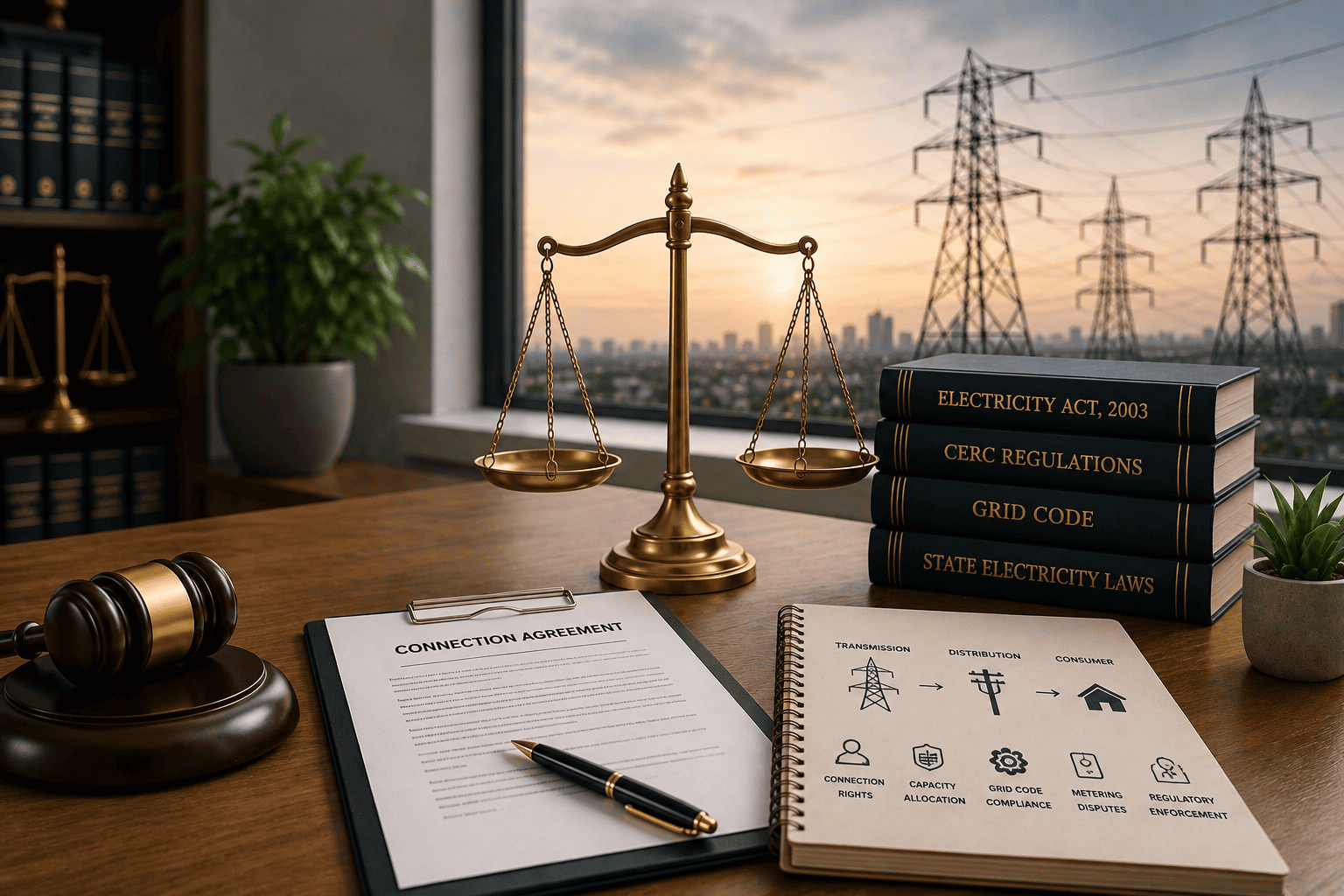
The transmission and distribution infrastructure carrying electricity from generator to consumer generates its own set of legal disputes — over connection rights, capacity allocation, cost sharing, grid code compliance, and regulatory enforcement.
We advise on:
- Transmission connectivity disputes — access rights to the inter-state transmission system, connection agreements, and capacity allocation before CERC
- Intra-state transmission disputes before SERCs — wheeling agreements, loss allocation, and transmission constraint compensation
- Distribution licence disputes — parallel distribution licence applications, franchise arrangements, and enforcement proceedings
- Grid code violation proceedings — defending generators and traders against Load Dispatch Centre penalties
- Metering disputes — meter reading accuracy, billing errors, and demand charge assessments
The Forum Landscape for Electricity Disputes in India — Knowing Where to Fight
One of the most consequential decisions in any electricity dispute is forum selection. Choosing wrong wastes years and money. Choosing right determines the speed, the remedies available, and often the outcome itself.
- SERC — the starting point for most intra-state disputes, including PPA matters, tariff issues, open access, and consumer complaints. Orders are final within the state but appealable to APTEL.
- CERC — handles inter-state transmission, central generating station tariffs, and multi-state disputes. Orders are appealable to APTEL.
- APTEL — the national appellate forum for all CERC and SERC orders, required to endeavour disposal within 180 days. Appeals lie directly to the Supreme Court under Section 125, on questions of law only.
- Supreme Court of India — decides substantial questions of law from APTEL orders, including landmark rulings such as Energy Watchdog on force majeure and the 2026 ruling on declared capacity and strict liability.
- Arbitration — available for non-tariff contractual disputes where the PPA contains an arbitration clause, subject to the tariff/non-tariff boundary set by APTEL and Supreme Court precedent.
- High Courts — retain writ jurisdiction under Article 226 even over matters within the APTEL framework, available for constitutional challenges or where the statutory forum can't provide adequate relief.
Since 2007, Amicus Publico LLP has been providing high-quality, comprehensive, and affordable legal solutions under one roof to corporates, govt. and indivisuals across India. Getting this right — including limitation periods and interim relief mechanisms at every stage — is a core strength of our electricity law dispute practice.
CONCLUSION
Speak to a Top Electricity Law Dispute Firm in India — Before the Tariff Order Becomes Final or the PPA Clock Runs Out
In electricity law, limitation periods are unforgiving. An APTEL appeal must be filed within forty-five days of the SERC or CERC order. A Supreme Court appeal from APTEL must be filed within sixty days. Miss either window, and the order stands, regardless of how strong the underlying case might have been.
PPA disputes carry their own contractual notice requirements, cure periods, and forum-invocation timelines. In curtailment and scheduling disputes, waiting too long to assert a right can be used against you as acquiescence.
The electricity sector doesn't pause. Your legal strategy shouldn't either.
Amicus Publico LLP is a Top Electricity Law Dispute Firm in India with the regulatory depth, tribunal experience, and sector knowledge to represent your interests at every stage — from SERC petition through APTEL appeal to Supreme Court review.
Hire an Electricity Law Dispute Firm in India that understands the sector as well as it understands the law — Contact Amicus Publico LLP today.
FREQUENTLY ASKED QUESTIONS
Electricity law in India is primarily governed by the Electricity Act, 2003, which sets out the regulatory framework for generation, transmission, distribution, trading, and use of electricity. The Act created CERC and the SERCs as the primary regulatory and dispute resolution bodies, and APTEL as the national appellate forum. Beyond the Act itself, disputes are shaped by CERC/SERC regulations, PPA terms, the Grid Code, and a growing body of APTEL and Supreme Court case law on tariff, open access, and Change in Law.
Electricity disputes move through a tiered system: SERCs handle intra-state matters (PPA disputes, tariff issues, open access, consumer complaints); CERC handles inter-state transmission and central generating station tariffs; APTEL hears appeals from all CERC and SERC orders, targeting disposal within 180 days; and the Supreme Court hears appeals from APTEL directly on questions of law under Section 125, bypassing the High Courts. Non-tariff contractual disputes can go to arbitration where the PPA provides for it.
A Change in Law clause lets either party seek tariff or contract adjustment when a change in legislation, regulation, or applicable law materially affects a project's economics after the agreed reference date. Common triggers include new taxes, changed import duties, revised environmental requirements, and judicial decisions that alter the regulatory landscape. It's one of the most heavily litigated areas of Indian power sector law, with quantification and eligibility tests refined continuously through CERC, SERC, APTEL, and Supreme Court decisions.
Partly. APTEL has drawn a firm line between tariff-related disputes — which must go before the SERC or CERC — and non-tariff commercial disputes, such as late payment surcharges, liquidated damages, termination compensation, and indemnity claims, which are arbitrable where the PPA has an arbitration clause. Filing in the wrong forum has real procedural consequences, so it's worth getting legal advice on forum selection before initiating any proceeding.
The Appellate Tribunal for Electricity is the statutory appellate body under Section 111 of the Electricity Act, 2003, hearing appeals from CERC, all SERCs, and Joint Electricity Regulatory Commissions. Appeals must be filed within forty-five days, though delay can be condoned for sufficient cause. APTEL can confirm, modify, or set aside orders, and holds supervisory power under Section 121 to direct Commissions on statutory compliance. Its rulings can be appealed directly to the Supreme Court under Section 125 on questions of law.
Open access lets eligible consumers — mainly large commercial and industrial users above a set demand threshold — buy electricity from any supplier through the transmission or distribution network, instead of only their local DISCOM. Disputes typically centre on cross-subsidy surcharges, wheeling charges, and additional surcharges that determine whether open access is financially worthwhile, along with disputes over application rejections, banking policy, and captive power arrangements. These are resolved before the relevant SERC, with appeal to APTEL.
The Draft NEP 2026, released for public consultation in January 2026, proposes mandatory tariff orders before each financial year, true-up completion within the same year, and a 120-day cap on regulatory proceedings. Once notified, these changes will give generators and consumers new grounds to enforce timely tariff determination and challenge Commission delays. The policy also points toward renewable energy, virtual PPAs, and decentralised generation — all of which will generate new categories of disputes as the energy transition accelerates.
DISCOM payment defaults are among the biggest financial risks Indian power generators face. Where a DISCOM fails to pay for contracted energy, generators can claim late payment surcharge under the Electricity (Late Payment Surcharge and Related Matters) Rules, 2022, and can also seek relief through the SERC, APTEL, or the High Court. Persistent default can justify PPA termination. In serious cases — such as Punjab's PSPCL accumulating ₹2,582 crore in dues by 2025-26 — generators have secured High Court orders barring alienation of DISCOM assets. Prompt legal action through the correct forum remains the most effective remedy.
Talk to a Top Corporate Law Firm in India
Before problems become legal disputes, we'll make the law work in your favour. From contract drafting to regulatory decision-making, our team delivers practical, business-focused legal advice.