
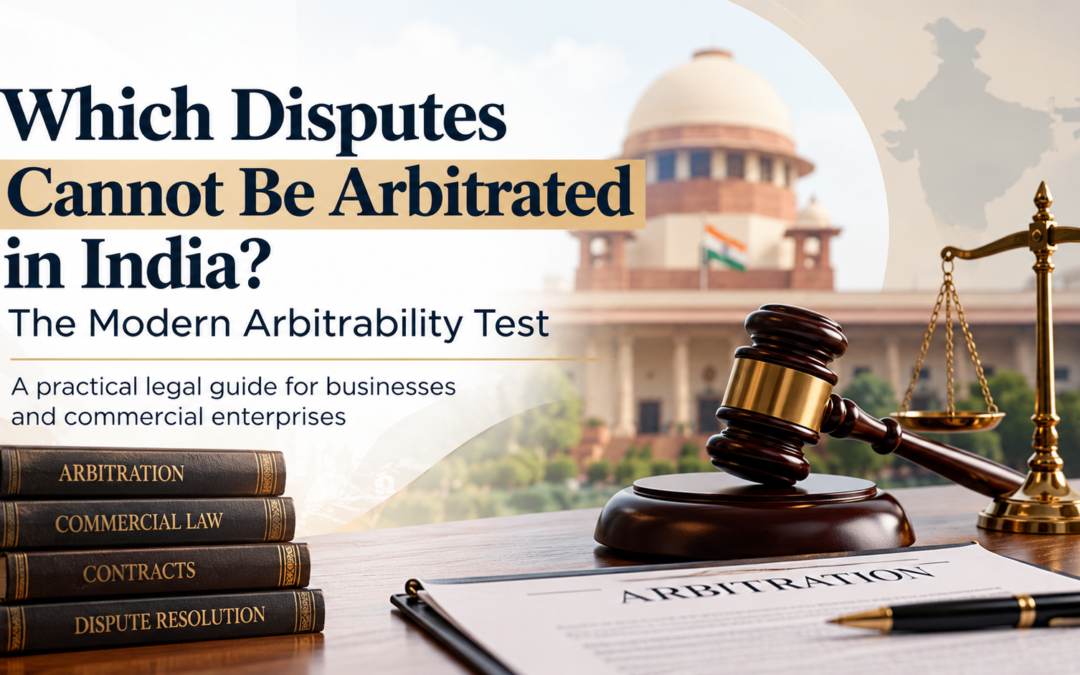
Which Disputes Cannot Be Arbitrated in India? The Modern Arbitrability Test
A practical legal guide for businesses and commercial enterprises
Introduction
Arbitration is widely used to resolve commercial disputes in India. However, the existence of an arbitration clause does not mean that every dispute can be decided by a private arbitrator. Certain matters must be determined by courts or statutory authorities because they involve public rights, third-party interests or remedies reserved by law to specialised forums. Understanding non-arbitrable disputes in India is therefore essential when drafting contracts and choosing a dispute-resolution mechanism.
1. Where Does the Law Draw the Line?
The Arbitration and Conciliation Act, 1996, does not provide an exhaustive list of non-arbitrable disputes. Section 2(3) recognises that other laws may restrict arbitration. Further, Section 34 permits an arbitral award to be set aside on specified grounds, including where the subject matter is not capable of settlement by arbitration under Indian law. Section 48 contains corresponding grounds for refusing enforcement of certain foreign awards.
2. The Modern Arbitrability Test
In Booz Allen & Hamilton Inc. v. SBI Home Finance Ltd., (2011) 5 SCC 532, the Supreme Court distinguished between rights in rem, which operate against the world at large, and rights in personam, which are enforceable against specific persons. Rights in personam are generally arbitrable, although certain subordinate rights arising from rights in rem may also be arbitrated.
The leading modern authority is Vidya Drolia v. Durga Trading Corporation, (2021) 2 SCC 1. The Supreme Court formulated a fourfold test to identify non-arbitrable disputes. In substance, a dispute may be non-arbitrable where it:
- Concerns rights in rem rather than merely private rights between parties.
- Affects third-party rights or requires a centralised determination binding on multiple stakeholders.
- Involves inalienable sovereign or public functions of the State.
- Is excluded from arbitration by a mandatory statute, expressly or by necessary implication.
These principles must be applied together, considering the nature of the dispute, the relief sought and the governing legislation.
3. Which Disputes Are Generally Non-Arbitrable?
The following categories are generally excluded from private arbitration:
Criminal offences
Criminal guilt and punishment must be determined through the criminal justice system. A related civil or contractual claim may nevertheless be arbitrable.
Matrimonial and guardianship matters
Divorce, judicial separation, child custody and guardianship ordinarily require adjudication by competent courts because they involve personal status and statutory considerations.
Insolvency and winding-up proceedings
These proceedings affect creditors and other stakeholders collectively and generally require statutory, centralised adjudication.
Testamentary disputes
Questions concerning the grant of probate or letters of administration ordinarily fall within the jurisdiction of competent courts.
Statutory employment claims
In Dushyant Janbandhu v. Hyundai AutoEver India Pvt. Ltd., 2024 INSC 966, the Supreme Court held that the wage and termination disputes before it was non-arbitrable because statutory authorities had exclusive jurisdiction under the applicable legislation.
The governing statute is crucial. A dispute is not non-arbitrable merely because it concerns employment, a company or a regulated industry.
4. Important Exceptions: What Can Still Be Arbitrated?
In Vidya Drolia, the Supreme Court clarified that ordinary landlord–tenant disputes governed by the Transfer of Property Act, 1882, are generally arbitrable. However, where special rent-control legislation confers exclusive jurisdiction on a designated forum, arbitration may be excluded.
Fraud allegations also require careful examination. In A. Ayyasamy v. A. Paramasivam, (2016) 10 SCC 386, and Avitel Post Studioz Ltd. v. HSBC PI Holdings (Mauritius) Ltd., (2021) 4 SCC 713, the Supreme Court explained that an allegation of fraud does not automatically make a dispute non-arbitrable. The nature of the allegations and the relief sought matter.
5. Who Decides Arbitrability?
Under Section 16 of the Arbitration and Conciliation Act, 1996, an arbitral tribunal may rule on its own jurisdiction. At the referral stage, courts generally conduct a limited examination rather than undertaking a full trial. However, where non-arbitrability is apparent, the court need not refer the dispute to arbitration merely because an arbitration clause exists.
Conclusion
An arbitration clause is valuable, but its effectiveness depends on the legal nature of the dispute. Applying Booz Allen and Vidya Drolia, alongside subsequent Supreme Court decisions, helps parties identify the limits of arbitration, avoid unnecessary proceedings and select the appropriate forum.
Frequently Asked Questions
Q1. Which disputes cannot be arbitrated in India?
Criminal liability, matrimonial status, guardianship, testamentary proceedings and insolvency matters are generally non-arbitrable. Disputes expressly or implicitly reserved by law to exclusive statutory forums may also be excluded.
Q2. Does an allegation of fraud make a dispute non-arbitrable?
No. Fraud does not automatically bar arbitration. Courts examine the nature of the allegations, the rights involved and whether the dispute is otherwise legally capable of arbitration.
Q3. Is landlord–tenant disputes arbitrable?
Generally, yes, where governed by the Transfer of Property Act, 1882. Arbitration may be excluded where applicable rent-control legislation confers exclusive jurisdiction on a statutory forum.
Q4. Can employment disputes be referred to arbitration?
Some contractual employment disputes may be arbitrable. However, statutory claims reserved to specialised authorities, such as the wage and termination disputes considered in Dushyant Janbandhu, may be non-arbitrable.
Q5. Who determines whether a dispute is arbitrable?
The arbitral tribunal can decide its jurisdiction under Section 16. Courts also examine arbitrability when exercising their statutory referral, setting-aside or enforcement powers.
Q6. What happens if a non-arbitrable dispute is decided by an arbitrator?
An award may be challenged under Section 34 where the statutory grounds are established. Enforcement of a foreign award may also be resisted under Section 48 on applicable grounds.
References
Legislation
- The Arbitration and Conciliation Act, 1996, Sections 2(3), 16, 34 and 48.
- The Transfer of Property Act, 1882.
Judicial Authorities
- Booz Allen & Hamilton Inc. v. SBI Home Finance Ltd., (2011) 5 SCC 532.
- A. Ayyasamy v. A. Paramasivam, (2016) 10 SCC 386.
- Vidya Drolia v. Durga Trading Corporation, (2021) 2 SCC 1.
- Avitel Post Studioz Ltd. v. HSBC PI Holdings (Mauritius) Ltd., (2021) 4 SCC 713.
- Deccan Paper Mills Co. Ltd. v. Regency Mahavir Properties, (2021) 4 SCC 786.
- Dushyant Janbandhu v. Hyundai AutoEver India Pvt. Ltd., 2024 INSC 966.
Casino reviews are among the most read pages in the industry and among the least neutral. Most sites publishing them earn a commission when a reader signs up, which shapes what gets covered and how warmly. Knowing that does not make reviews useless, only in need of careful reading.
Reading Casino Reviews Critically
The verifiable parts of a review are the ones to weigh: licence number, payout ceilings, verification requirements and complaint history. Anyone cross checking claims can Fox Slots and compare what different sources report about the same operator. Tone and star ratings are cheap to produce, while a documented payout timeline takes actual work.
| Signal | What It Suggests |
|---|---|
| No stated drawbacks | Likely promotional content |
| Affiliate disclosure | Basic transparency |
| Dated payout test | Real hands on checking |
- Check whether the review names any real drawback
- Verify the licence number at the regulator directly
- Compare at least two independent sources
Reviews are a starting point for a shortlist and a poor basis for a final decision. The facts they contain can be verified independently, and anything that cannot be verified is opinion. Use them to narrow the field, confirm the licence yourself, and set a deposit budget before registering anywhere.