
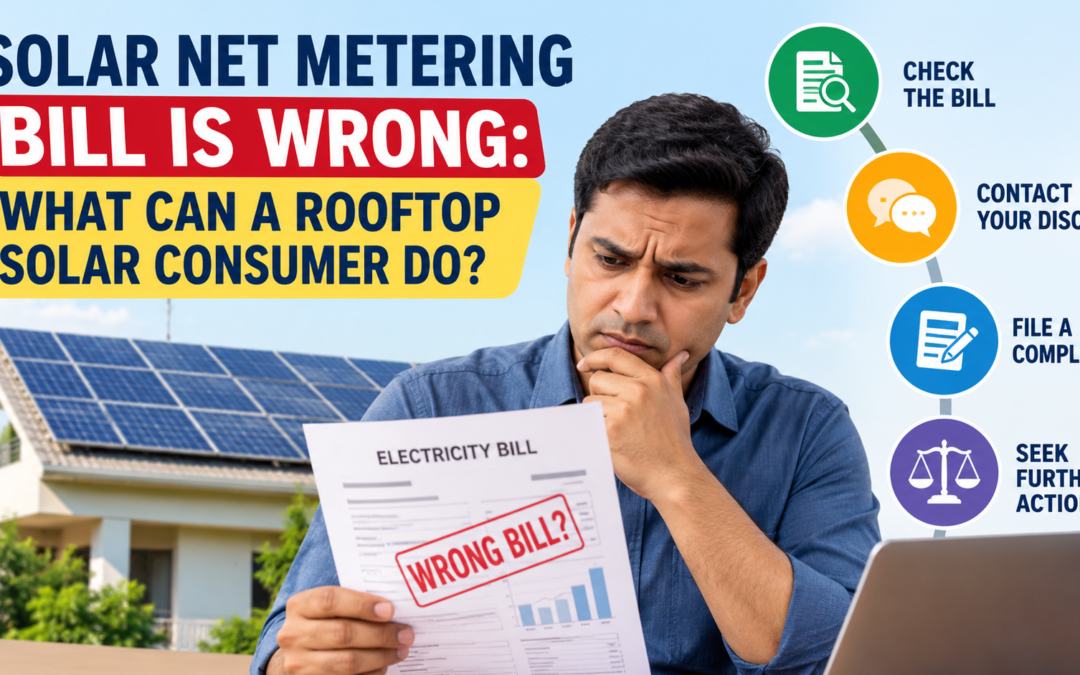
Mr. A decided to install rooftop solar panels at his home. His electricity bills had been increasing, and he believed solar power would help reduce his monthly expenses.
After the installation, Mr. A started generating electricity during the day. His house used some of the electricity, while the extra power was sent back to the electricity grid through a net meter. Mr.A expected his next electricity bill to be much lower.
WHAT IS NET METERING ?
Net metering is a system under which a rooftop solar consumer can export surplus electricity generated by the solar panels to the electricity distribution grid.
For example:
1.Solar panels generate 10 units.
2.The household uses 6 units.
3.The remaining 4 units can be exported to the grid.
4.The electricity you take from the grid is adjusted against the extra electricity your solar panels send back, according to the applicable rules.
But when the bill arrived, he was surprised. The amount was still quite high.
Mr.A checked the bill and noticed that the electricity exported by his solar system did not seem to have been properly adjusted. He wondered, “If my solar panels are sending electricity to the grid(public electricity network), why am I being charged so much?”.
WHAT SHOULD A CONSUMER DO?
The consumer should compare:
- Previous and current meter readings.
- Imported electricity.
- Exported electricity.
- Solar generation records, where available.
- Billing period.
- Tariff and additional charges.
Then contacted the electricity distribution company and raised a written complaint. If the issue was not resolved, A could take the complaint to the Consumer Grievance Redressal Forum (CGRF) and, where applicable, Higher complaint authority.
WILL YOUR ROOFTOP SOLAR STILL SAVE YOU MONEY ? WHAT MAHARASTRA’S NEW RULE MEAN FOR YOUR BILL.
The Maharashtra Electricity Regulatory Commission (MERC) issued draft rooftop renewable energy regulations in September 2026 proposing significant revisions to solar accounting and billing
Monthly Settlement for Systems Above 3 kW: Under the proposed framework, surplus energy generated by systems larger than 3 kW would no longer carry forward across billing cycles on an annual basis. Instead, unused credits would be settled on a monthly basis, reducing the financial benefit of banking surplus units during peak summer months for winter/monsoon usage.
Protection for Small Systems (Up to 3 kW): Rooftop systems up to 3 kW—which cover the majority of smaller residential households under schemes like PM Surya Ghar—are slated to retain annual banking and settlement.
DON’T JUST COMPLAIN. ESCALATE.
When your power company messes up your bill, delays your solar meter, or keeps your deposit, standard customer support is rarely enough.
That’s why the Consumer Grievance Redressal Forum (CGRF) exists: a dedicated, low-cost legal forum designed specifically to hold electricity companies accountable. No complicated legal jargon, no hefty attorney fees—just a direct way to get your money and power sorted.
CONCLUSION
You didn’t invest in rooftop solar just to pay for someone else’s billing error. Don’t accept a questionable bill. Compare your import and export units, keep your records straight, and raise a formal complaint with your power company. If they ignore you, the consumer forums exist to back you up. Knowing your numbers is your best defence.
“The panels are on the roof, the meter is on the wall, but the power to question the bill is in your hands.”
Frequently Asked Questions
Q1. Where do I actually find imported vs. exported units on my bill?
Your electricity bill features a dedicated section showing the bi-directional meter readings. You will see two key metrics: Active Import (kWh) (power drawn from the grid) and Active Export (kWh).
Q2. How long must I wait after filing a complaint with the Distribution company before I can approach the CGRF?
Under MERC regulations, you can approach the Consumer Grievance Redressal Forum (CGRF) if:
- The Discom’s Internal Grievance Redressal Cell (ICRC) fails to resolve the issue within two months, or
- The ICRC dismisses your complaint or provides an unsatisfactory resolution.
Q3. Do I need to hire a lawyer to file a case in the CGRF?
No. CGRF is intended to be consumer-friendly, accessible, and virtually zero-cost. Consumers can draft and file the complaint themselves using the standardized Schedule A form, or nominate a representative. In fact, under MERC rules, practicing advocates are generally barred from appearing unless specific procedural exceptions apply
Q4. What should I check first if my solar bill arrives unexpectedly high?
Before panicking, compare your previous and current meter readings, imported units, exported units, available solar generation logs, the billing period, and the tariff or extra charges applied.
Q5. How will the proposed MERC draft rules affect systems larger than 3 kW?
For rooftop solar installations above 3 kW, surplus energy will no longer carry forward across billing cycles on an annual basis. Instead, unused credits will be settled every month, reducing the advantage of banking excess summer power for winter or monsoon months.
Q6. What should I do if the power company ignores my written billing complaint?
No. Court involvement is a built-in part of the arbitration framework. A timely court application, such as for interim protection or the appointment of an arbitrator, usually helps the arbitration proceed. Problems arise only when a party approaches the wrong forum or does so at the wrong time.
Q7. What can I do if the CGRF rejects my claim or fails to issue an order within 60 days?
If you are aggrieved by a CGRF order—or if the forum does not decide your case within the stipulated time—you can file an appeal before the statutory Electricity Ombudsman within 30 days.
BIBLIOGRAPHY