
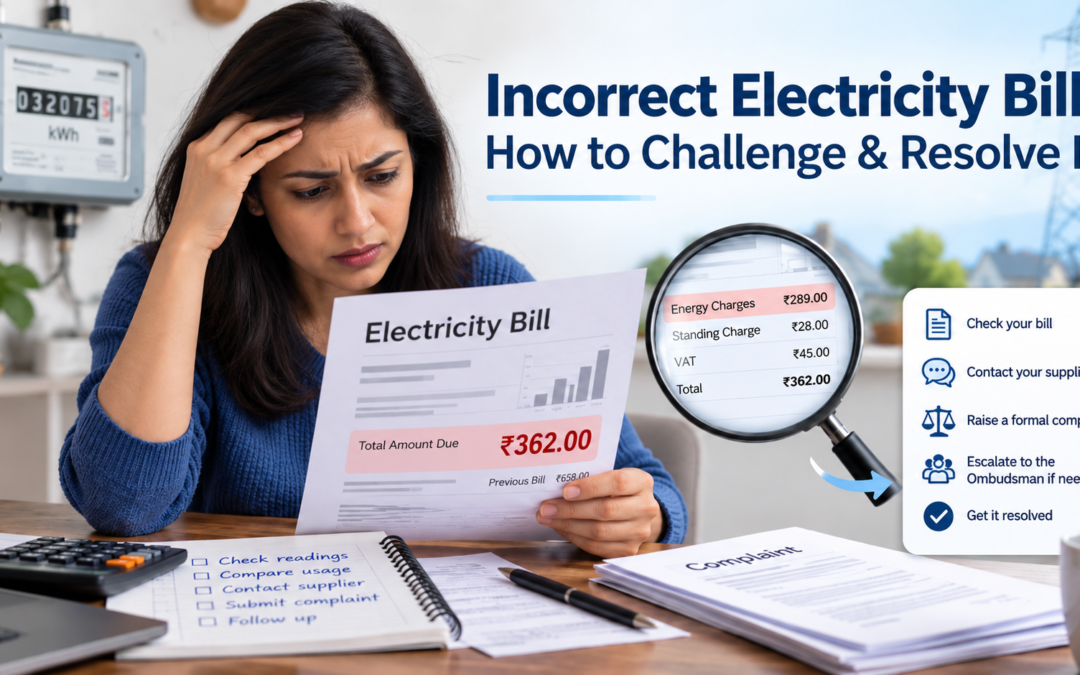
Opening your electricity bill and seeing a shockingly high or unfamiliar charge is stressful. But the good news is that the law gives consumers real, strong rights to question and fix incorrect bills.
Your Legal Right to Push Back
Electricity is legally treated as a “good,” much like any product you buy. Courts have confirmed this, and because of it, the relationship between you and your power company is a contract. You only owe money for what you actually use — and if a bill doesn’t reflect that, you have a legal right to challenge it. Laws like the Electricity Act, 2003, are designed to protect consumers while still letting power companies collect what they’re genuinely owed.
The Usual Suspects Behind a Bad Bill
Before you complain figure out exactly what’s wrong. The most common billing errors are:
-
Wrong meter readings — the number on your bill doesn’t match your actual meter.
-
Inflated estimated bills — when the meter reader can’t access your meter, the company guesses your usage based on old data and this guess is often too high.
-
Wrong tariff category — for example: being charged commercial rates for a home connection.
-
Extra, uncontracted charges — fees for services like maintenance or insurance that you never asked for.
-
Wrong identification code — your bill gets mixed up with someone else’s property because of an incorrect installation or supply code.
-
Simple math mistakes — wrong tariff slab calculations, duplicate charges or overlapping billing periods.
-
Sudden back-billing — being charged out of nowhere for past months with no clear explanation.
The Fine Print That Actually Protects You
Two important rules protect you:
- 1. Time limit on old dues — A power company generally cannot chase you for unpaid charges more than two years after the bill was first issued. Even though your liability starts the moment you consume electricity, the clock only starts once a formal bill is actually sent to you.
- 2. No disconnection during a dispute — This is crucial. If you’re disputing part of a bill, the company cannot cut your power as long as you pay the undisputed portion or an amount based on your average bill from the last six months. Always pay this part on time — ideally through a traceable method like an online portal — so you have proof of payment while your dispute is being resolved.
If you’ve bought a new property, note that you are usually not responsible for the previous owner’s unpaid bills, since there’s no contract between you and them. That said, some power companies have rules requiring old dues to be cleared before a new connection is issued, so it’s wise to check bill history and add a clearance clause before finalizing any property purchase.
Your Action Plan: From Complaint to Resolution
-
Step 1: Complain to the power company first.
Call the helpline or use the online portal to raise your issue, and always get a complaint reference number. If nothing happens, put your complaint in writing to the Grievance Redressal Officer. Companies are typically required to respond within 15 to 30 day.
-
Step 2: Escalate to the Consumer Grievance Redressal Forum (CGRF).
If the company doesn’t fix things in time take your case to the CGRF, a body every power company is required to set up. Submit your bill, meter photos, older bills and all your complaint records as evidence.
-
Step 3: Go higher if needed.
Still unhappy? Appeal to the Electricity Ombudsman for an independent review. For bigger, systemic issues like wrong tariffs affecting many customers — you can approach the State Electricity Regulatory Commission. As a last resort the consumer courts or civil courts are also open to you.
Paper Trail: Your Best Friend in a Dispute
Strong evidence makes your case far more convincing. Collect:
- Clear and dated photos of your physical meter.
- Your disputed bill plus two or three previous bills for comparison.
- A written log of every complaint number, date, and email.
- A meter accuracy test report, if you suspect a faulty meter.
What’s In It for You
If your dispute is successful, you’re entitled to real remedies: corrected bills based on actual usage, refunds or credits (sometimes with interest) on future bills and in serious cases, the compensation ordered by regulators. If a mistake worked in the company’s favor, they usually must adjust it going forward; if it worked against you, repayments can even be spread out over time.
“Don’t panic over an incorrect bill — pay the undisputed amount to stay safe from disconnection, gather solid proof, and escalate calmly through the proper channels. With the right evidence and persistence, most billing disputes can be resolved fairly”
FREQUENTLY ASKED QUESTIONS
Q1. Can I simply refuse to pay an electricity bill I believe is wrong?
No. You must still pay the undisputed portion of the bill, or an amount based on your average bill from the last six months, while your dispute is being resolved. Paying this protects you from disconnection and gives you proof of good faith.
Q2. What are the most common reasons a bill turns out to be incorrect?
Wrong meter readings, inflated estimated bills, an incorrect tariff category, extra uncontracted charges, a mixed-up identification or supply code, simple slab or arithmetic errors, and sudden unexplained back-billing.
Q3. Is there a time limit on how far back a power company can chase unpaid dues?
Generally two years from when the bill was first issued — the clock starts once a formal bill is actually sent, not from when the electricity was consumed.
Q4. Can the power company disconnect my connection while I’m disputing a bill?
No, as long as you keep paying the undisputed portion, or an amount based on your average usage over the last six months, on time and through a traceable method.
Q5. If I buy a property, am I responsible for the previous owner’s unpaid electricity bills?
Usually not, since there’s no contract between you and the previous owner. However, some power companies require old dues to be cleared before issuing a new connection, so it’s worth checking the bill history and adding a clearance clause before finalizing the purchase.
Q7. What remedies am I entitled to if my billing dispute is upheld?
Corrected bills based on actual usage, refunds or credits (sometimes with interest), compensation in serious cases, and if the error worked against you, repayments can even be spread out over time.