
Two home guards were beaten with iron rods for showing up at someone’s door
with a checklist.
Not a police raid. Not a recovery agent visit.
That’s how seriously India takes power theft and why every consumer, industry,
lawyer needs to know the difference between these two sections of the Electricity
Act, 2003.
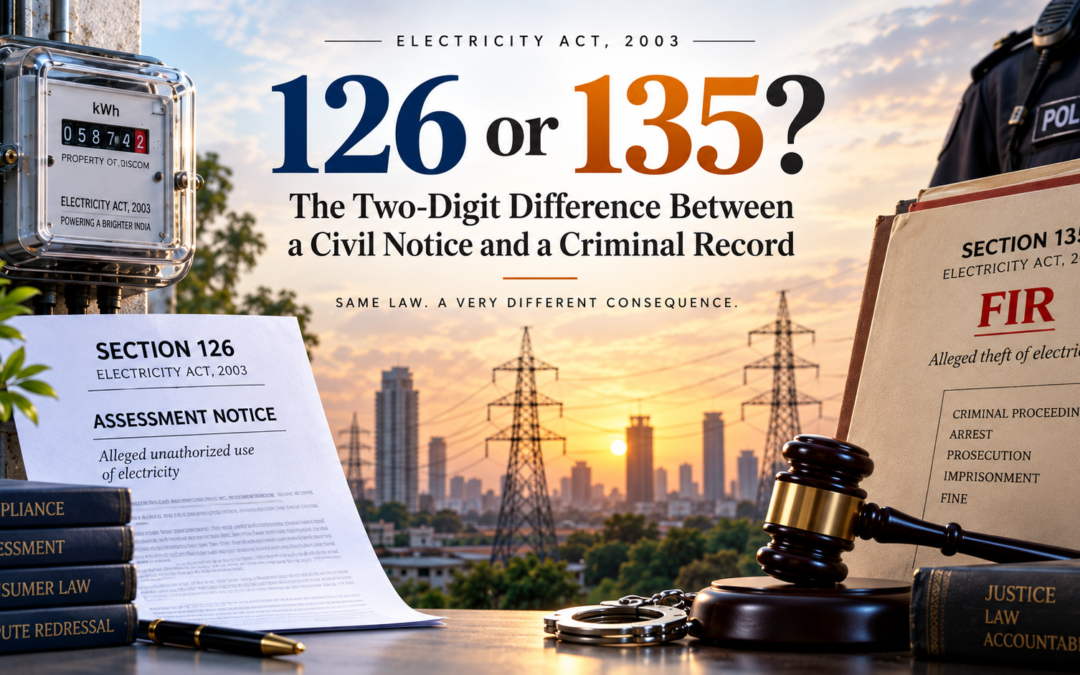
That mystery has a name-Section 126 and 135, two digits apart on paper. A
universe apart in real life
THE WAR NOBODY TALKS ABOUT AT DINNER
Why would a discom send armed escorts with meter-readers in the first place?
- India loses close to ₹1.32 lakh crore every year to power theft
- Adani Electricity booked 5,897 theft cases worth ₹43.39 crore in FY 2025-
26 after 36,720 raids.
It’s a full-blown enforcement war and one Act decide which side you’re on.
MEET SECTION : THE PAPERWORK PROBLEM
Section 66 is an important mechanism used by the Resolution Professional to expand the pool of assets available for creditors by seeking contributions from individuals responsible for misconduct.
A small garment workshop, the owner signed up for a domestic connection
years ago, back when it really was just a house. Slowly, a couple of sewing
machines came in. Then a few more. Then a cutting table . Nobody switched
a connection category—- it just grew.
Will that count as a theft?
Using power for a purpose you weren’t sanctioned for. Pulling more load than
your contract allows. Running a factory on a domestic connection
No dishonest intention needed. The officer assesses, you object, an order is
passed, and you can appeal
An expensive billing dispute.
MEET SECTION 135 : THE WIRE IN THE DARK
Now a different house, a few streets away. Someone climbed a pole after
midnight and hooked a bare wire into the main line, bypassing the meter
altogether
That single word- deliberately changes everything about what happens next. This
isn’t an assessing officer’s order anymore. It becomes a police complaint, an FIR,
a prosecution that must prove both the act and the dishonest intent, beyond
reasonable doubt, in a courtroom.
THE TWIST: EVEN DISCOMS GET THIS WRONG
If the tribunal concludes that fraudulent or wrongful trading occurred, it has wide powers to pass appropriate orders.
Weeks ago, in M/s Himadri Steel Pvt. Ltd. v. Jharkhand Urja Vikas Nigam Ltd.
(2026 INSC 851), the Court struck down a ₹3.23 crore assessment under Section
135
The line was blunt: Section 126 needs no intent, Section 135 does you can’t
shortcut that because the number looks bigger.
“A high bill isn’t automatically theft. Not every FIR under the Act survives
scrutiny. Every discom cutting corners on inspection is one bad panchnama
away from losing in the Supreme Court”
FREQUENTLY ASKED QUESTIONS
What is the difference between Section 126 and Section 135 of the Electricity
Act, 2003?
Section 126 deals with the unauthorised use of electricity and assessment of
electricity charges, while Section 135 concerns electricity theft involving
dishonest or deliberate conduct. The key distinction highlighted in the blog is
the role of dishonest intent.
What is Section 126 of the Electricity Act, 2003?
Section 126 applies when electricity is used in an unauthorised manner, such as
using electricity for a purpose different from the sanctioned purpose or drawing
more load than permitted. The matter generally involves an assessment,
objections and an appeal process.
What is Section 135 of the Electricity Act, 2003?
Section 135 deals with electricity theft. The blog illustrates this with deliberate
acts such as directly connecting a wire to the electricity supply and bypassing
the meter. Such allegations can lead to an FIR and criminal prosecution.
Does Section 126 require dishonest intention?
According to the distinction discussed in the blog, dishonest intention is not
required for proceedings under Section 126. An unauthorised use may therefore
result in an assessment even without an intention to steal electricity.
Does Section 135 require dishonest intention?
Yes, the blog identifies dishonest or deliberate intent as an important distinction
in a Section 135 electricity-theft case. It states that a prosecution must establish
both the alleged act and dishonest intent in court.
Is using a domestic electricity connection for commercial purposes electricity
theft?
Not automatically. The blog uses the example of a domestic connection later
being used for a garment workshop to explain how such use may fall within
Section 126 as unauthorised use, rather than automatically becoming criminal
electricity theft under Section 135.